Connection and student agency are at the heart of the Upper School experience, as students are encouraged to take ownership of their learning with the support of invested faculty and peers.
Upper School students are continually honing their mastery of Brookwood’s Mission in Practice: collaboration, risk-taking, respectful and clear communication, critical and creative thinking, and being responsible for themselves, the care of others, and the environment around them.
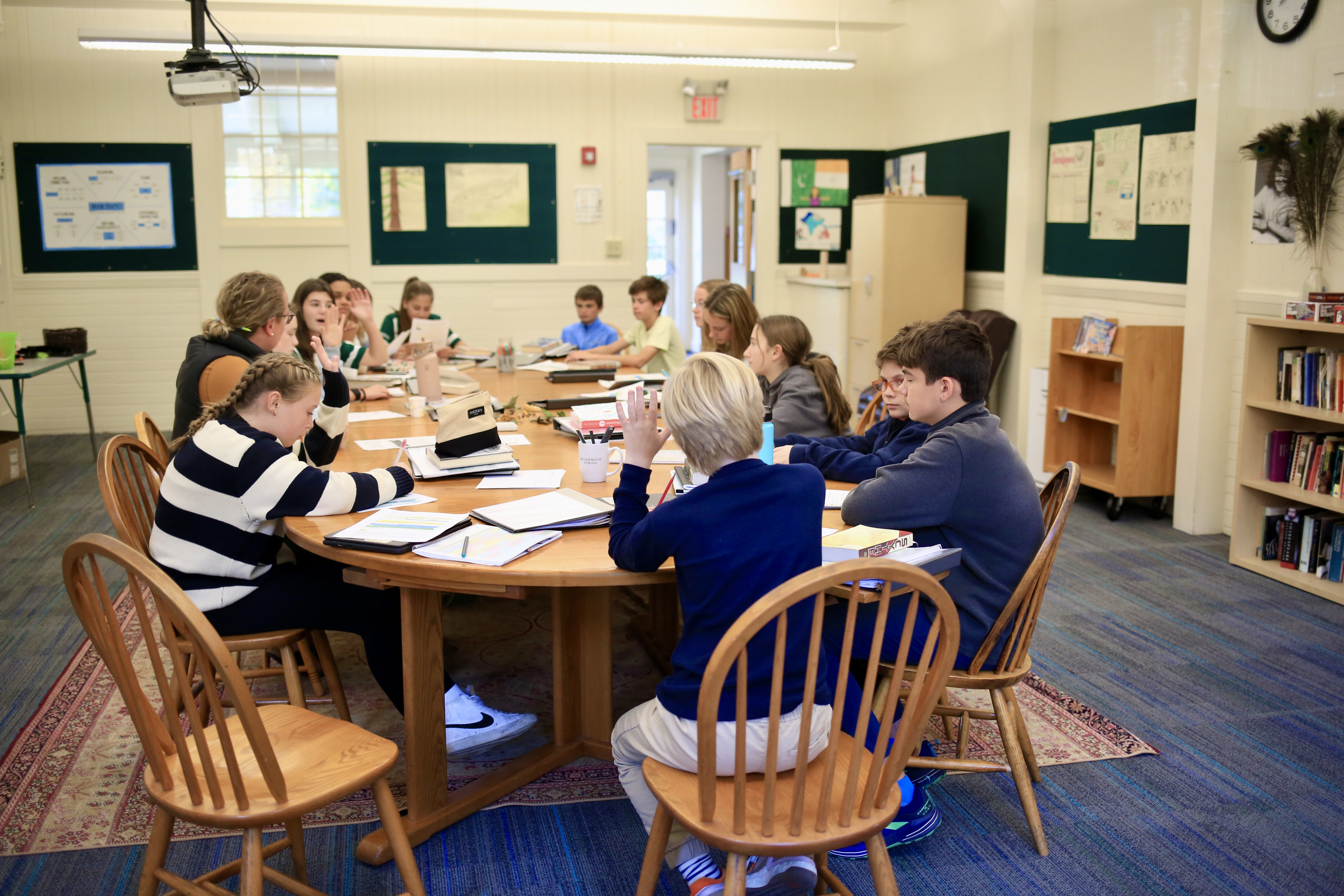
Meaningful Relationships
Our faculty know how adolescents learn best and intentionally build a community of connection that fosters meaningful relationships, student engagement, challenge, and growth from grades 5 through 8.
At Brookwood, authentic relationships between students and teachers nurture, motivate, and encourage competence and confidence in our students. Through the integration of individuality and skill-building, students establish a solid foundation and a deep sense of self with which to build and explore more complex academic pursuits both at Brookwood and beyond.
Explore Our Upper School Courses
Grades 5-8
Changemaking is designed to empower students as creative thinkers, problem-solvers, and active contributors to their community and the world around them. Rooted in design thinking and hands-on learning, this course invites students to identify real-world challenges, explore meaningful questions, and develop innovative solutions through making, building, and iteration.
This interdisciplinary course intentionally connects to and extends the core academic program. Students will apply mathematical reasoning to measure, model, and optimize their designs; draw on scientific principles to test ideas and understand cause and effect; engage in research, writing, and storytelling to communicate their thinking with clarity and purpose; and use historical and social context to ground their work in real human experiences. In doing so, the makerspace becomes a living laboratory where academic skills are not only practiced, but applied in authentic and meaningful ways.
Throughout the course, students will engage in collaborative projects that require empathy, critical thinking, and resilience. They will learn to prototype, test, reflect, and revise; developing both the mindset and skill set of a changemaker. Emphasis is placed on process over product, encouraging students to take intellectual risks, learn from failure, and iterate toward stronger outcomes.
Aligned with Brookwood’s mission, this course fosters a joyful community of learners who are curious, engaged, and thoughtful in their work. Students leave with a deeper understanding of how ideas move from concept to creation, and with the confidence that they have the ability to make a meaningful impact.
Grade 5 English
Students are introduced to the art of active reading through text annotation, learning to engage with stories by recording their immediate questions and reactions. Writing assignments help students find their voice through short personal narratives rich in sensory detail, alongside the development of concise summaries and clear explanatory paragraphs. Language study centers on building foundational accuracy, with a primary focus on mastering periods and capitalization in every sentence. Vocabulary is integrated directly from the curriculum's core texts, allowing students to study new words in context. Our reading list features a diverse collection of perspectives and formats. It has included Wonder, Heart of a Samurai, Because of Mr. Terupt, Sophia’s War, and Letters from Rifka. Students also explore contemporary themes through works such as Home of the Brave, the anthology America Street, and the graphic novel New Kid.
Grade 6 English
Students develop foundational reading and annotation skills to deepen comprehension and identify major themes across various genres. They are introduced to the concepts of imagery and characterization, applying these tools to both their analysis and original narrative writing. Assignments transition from creative storytelling to paragraph-length expositions and arguments that emphasize the initial use of evidentiary support. Students refine their work through a complete writing cycle—including drafting, revision, and publishing—supported by regular individual writing conferences. Language study focuses on sentence-level accuracy, specifically mastering capitalization, end marks, and basic comma usage. Core readings include The Giver, Holes, and Tristan Strong Punches a Hole in the Sky, along with classic short stories such as "To Build a Fire" and "The Tunnel."
Grade 7 English
Students work on reading accurately and in depth by exploring a variety of genres in this course. They learn the language of literary analysis and apply these terms to both creative writing and collaborative Harkness discussions. Students also learn to use purposeful annotation to enhance their engagement with texts. Written assignments include short arguments, fiction, and poetry, with an emphasis on incorporating the basics of logic. Regular lessons on grammar and usage focus specifically on mastering comma usage. Core works include Tom’s Midnight Garden, The House on Mango Street, the verse novel Long Way Down, and Shakespeare’s A Midsummer Night’s Dream.
Grade 8 English
Students learn to read with both resistance and respect, identifying the nuanced roles of the character, narrator, author, and reader within diverse literary works. They develop and test their interpretations through student-led Harkness discussions, which inform their writing of concise, logic-based arguments and full-length, self-themed essays. The curriculum also integrates nature journaling and multimedia projects. All writing assignments are supported by a rigorous revision process that includes peer review, conferencing, and careful editing. Grammar lessons emphasize sentence variety and the sophisticated use of commas, colons, and semicolons. Core texts include Watership Down, Braiding Sweetgrass for Young Adults, How I Discovered Poetry, To Kill a Mockingbird, and Romeo and Juliet.
Grade 5 History
The Grade 5 History curriculum invites students to become active investigators of the past and present by exploring the power of narrative and the complexities of the American experience. Students begin the year by developing the foundational analytical skills of a historian, moving beyond the memorization of dates to analyze primary and secondary sources, evaluate the reliability of evidence, and question whose voices are traditionally prioritized or omitted in historical accounts. This methodology is then applied to a study of global exploration, where students examine the diverse motivations and impacts of historical journeys while synthesizing diverse experiences through the creation of historical fiction journals and immersive research projects.
To bridge the gap between historical events and modern social structures, the course transitions into an examination of systemic marginalization and the "cycles" of exclusion. Using the lenses of media literacy and historical film, students identify how social and political power functions in society and develop the critical awareness necessary to recognize these dynamics in a modern context. This work extends into an analysis of economic systems, where students use simulations to understand the barriers that lead to inequitable wealth distribution and economic insecurity. To ground these concepts in civic action, the class engages in a direct partnership with Beverly Bootstraps; here, students transition from classroom theory to community practice by launching advocacy campaigns and public service announcements that address food security and local needs.
The final phase of the year centers on the intersection of geography and historical development. Through an immersive simulation, students apply technical mapping skills, including the use of scale, latitude, and longitude, to evaluate land based on its physical features, climate, and available natural resources. This study emphasizes how environmental factors and geographical location directly influence human choices, group survival, and the long-term success of land-based efforts. The curriculum concludes with a deep reflection on personal and national identity, inviting students to consider their own place within the American story. Throughout these studies, the primary goals are to cultivate critical thinking, evidence-based writing, and a sense of community agency, empowering students to synthesize how history, geography, and identity interact to shape both their own lives and the world around them.
Grade 6 History
Grade 6 American History covers the first first half of American history beginning with colonization and ending with the Civil War. Throughout our studies, there is a strong emphasis on expository writing with particular focus on the creation and support of a thesis using factual evidence from class. Each week, students work on crafting and supporting a thesis based on content from that week’s studies, and the expectations regarding this work increase as students demonstrate readiness to add more depth and detail. At the end of the year, students can consistently produce quality, five paragraph essays, that best utilize factual evidence to prove an argument. Of equal importance is an emphasis on civics and evaluation of sources as primary themes of the year. Throughout the winter, students explore the US Constitution in an effort to better understand how the government operates, and they examine various sources to help inform their studies. In this class we treat history and events as constantly evolving due to new information, perspective, bias, and factual evidence. Students complete this class with a strong complement of writing and evaluation skills that serve them well in all future social studies courses.
Grade 7 History
The Grade 7 History continues with the study of U.S. History and is designed to cultivate advanced historical thinking and civic engagement by integrating thematic units on industrialization, global conflict, and the American legal system. We begin with an analysis of how industrialization and the Progressive Era transformed the United States through technological innovation and social reform. The emphasis is on using that information to be able to read, think, and write like an historian, using a variety of primary and secondary sources. Students, then, investigate the complex causes and global consequences of World War I, the economic instability of the interwar years, and the rise of the Nazi Party leading into World War II. This historical study includes a mature examination of the Holocaust and a detailed comparison of major military strategies and turning point battles across the European and Pacific theaters. The course culminates in a hands-on Mock Trial unit, where students apply legal vocabulary, evidentiary rules, and trial procedures to argue a simulated criminal case. That exercise serves as a capstone for developing critical media literacy and oral communication, requiring students to synthesize complex evidence, apply legal standards, and practice the essential skills of collaborative advocacy and reasoned debate.
Grade 8 History
The author, William Faulkner, once wrote, “The past is never dead. It’s not even past.” At Brookwood, we strive to teach students that in order to understand who we are, we need to study and understand our history. In the new World History curriculum for the 8th grade, it can never be just the simple memorization of names and dates; that would be too complex and daunting a task. Rather, we will ask historical questions, analyze evidence from primary sources, and create arguments. The class will dive into the revolutions, empires, world wars, and social movements that shaped the world. Starting with the world in 1750, the course will explore powerful empires and global connections to fully understand the changes that are about to happen. As the world began to industrialize, students will investigate how the world both began to radically change and evolve into the modern world. Along the way, we will try to answer the question of what it means to live in a global world, and how we got there.
Grade 5 Mathematics
In Grade 5 mathematics, students strengthen their understanding of whole numbers, fractions, and decimals through rich, problem-based learning experiences. Using the Illustrative Mathematics curriculum, students develop fluency with multi-digit multiplication and division while making sense of fraction operations and decimal place value. Measurement concepts are extended through work with volume, and students analyze and represent data to draw meaningful conclusions. Throughout the course, students model their thinking with diagrams, equations, and words, engage in mathematical discussions, and apply their learning to real-world contexts, building a strong foundation for middle school mathematics.
Grade 6 Mathematics
The Illustrative Mathematics Accelerated Grade 6 program combines all Grade 6 content with selected Grade 7 concepts to support a faster pace toward algebra. Students explore ratios, rates, and percentages to develop strong proportional reasoning while extending their understanding of fractions and decimals to include positive and negative numbers. They learn to write, interpret, and solve expressions and equations, connecting numerical reasoning to algebraic thinking. Geometry concepts such as area, surface area, and volume are explored through modeling and problem solving. Emphasis is placed on reasoning, collaboration, and clear communication as students make sense of increasingly complex mathematical ideas.
Grade 7 Mathematics
The Illustrative Mathematics Accelerated Grade 7 program deepens students’ understanding of proportional relationships and extends their work with rational numbers through increasingly complex problem-solving. Students analyze linear relationships, solve multi-step equations, and explore the foundations of functions using tables, graphs, and equations. Geometric concepts such as scale, similarity, and angle relationships are used to connect algebraic and spatial reasoning. Through discussion-centered lessons, students learn to justify their thinking, recognize mathematical structures, and apply percent and proportional reasoning to real-world situations, preparing them for the formal study of Algebra 1.
Grade 8 Mathematics
Algebra 1 focuses on developing a deep understanding of algebraic relationships and their real-world applications. Students solve linear equations and inequalities, analyze systems of equations, and study linear, exponential, and quadratic functions through multiple representations including graphs, tables, and equations. Modeling is a central component of the course, as students use algebra to interpret data, identify patterns, and make predictions. Through the Illustrative Mathematics approach, students engage in mathematical argumentation, connect concepts across units, and build the reasoning skills necessary for success in advanced high school mathematics.
Grade 5 Performing Arts
In Grade 5 Music, students build on their foundation skills as musicians while exploring the vibrant musical traditions of the Caribbean. Throughout the year, students continue their study of music theory, strengthening their ability to read and interpret music in both treble and bass clefs and perform increasingly complex rhythmic patterns. During the fall semester, students dive into the world of steed drum music, learning proper technique, ensemble skills, and performance etiquette as they rehearse and present selections from Caribbean repertoire including, but not limited to, calypso, reggae, and soca. In the spring, students explore the transition of “tamboo bamboo,” discovering how everyday materials can be transformed into instruments. Using found sounds, students collaborate to compose and perform an original musical skit (a la “STOMP”). This course emphasizes creativity, cultural appreciation, collaboration, and musical literacy, empowering students to grow as confident performers, thoughtful listeners, and imaginative composers.
Grade 6 Performing Arts
Grade 6 Music is a year-long course focused on developing fundamental guitar skills while building students’ confidence as instrumentalists and ensemble musicians. Throughout the year, students learn proper posture, tuning, basic chord shapes, and introductory strumming and picking techniques, while strengthening their understanding of rhythm and musical notation (standard notation, tablature, and/or lead sheets). In the fall semester, students concentrate on guitar basics, including fretting technique, reading chord diagrams, and performing simple songs. In the spring semester, the class shifts toward preparing for a larger group performance, emphasizing ensemble playing, listening skills, and musical collaboration. As a culminating experience, students use these skills to explore songwriting, learning how melodies, chord progressions, rhythm, and tempo work together. Students are encouraged to contribute their own musical ideas and combine original music with lyrics and poetry to express their thoughts, ideas, and feelings. This course encourages perseverance, teamwork, creative expression, and provides students with a strong foundation for future musical study.
Grade 7 Performing Arts
Grade 7 Performing Arts is an immersive, year-long course that introduces students to advanced ensemble performance and the fundamentals of musical theater. Students develop musician, collaboration, and stagecraft skills through hands-on performance experiences that blend music and theater. In the fall semester, students learn to read handbell notation, refine rhythmic accuracy, and practice ensemble techniques as they prepare selections for performance at Brookwood’s annual Revels Concert in the winter. Emphasis is placed on listening skills, teamwork, and musical responsibility as students work together to create a polished large-ensemble performance.
In the spring semester, students transition into an introduction to musical theater, exploring acting, singing, movement, and character development. Students apply these skills as they rehearse and perform a short musical, gaining experience in the full production process from blocking to final performance.This course encourages confidence, creativity, and collaboration while fostering appreciation for both instrumental and theatrical performance traditions.
Grade 8 Performing Arts
Grade 8 Performing Arts is a culminating, performance-based course that immerses students in the full process of producing a large-scale theatrical production. Throughout the year, students work collaboratively on a full-length musical, deepening their skills in acting, vocal expression, movement, and ensemble performance. Beginning in the first weeks of the school year, students engage in auditions, character analysis, rehearsal techniques, and production responsibilities as they prepare for a spring performance for a public audience. Compared to the 7th grade production, this show is longer and more complex. Requiring a high level of commitment, focus, and artistic maturity. This course emphasizes discipline, collaboration, creative problem-solving, and confidence as students experience what it truly means to be part of a professional-style theatrical ensemble from the first rehearsal to the final curtain call.
Grade 5 Science
In Grade 5 Science, students explore the foundational concepts of ecosystems by studying the living and nonliving components that interact to support life. Using Brookwood’s Forest School as an outdoor classroom, students investigate local ecosystems through hands-on observation, data collection, and inquiry-based exploration. Topics include food webs, energy flow, plant and animal adaptations, habitats, and the roles of producers, consumers, and decomposers. Students examine how organisms depend on one another and their environment, while also considering the impact of human activity on ecosystems. Field studies around the campus encourage curiosity, critical thinking, and scientific reasoning as students learn to ask questions, make predictions, and communicate findings. Through experiments, outdoor investigations, and collaborative projects, students develop a deeper understanding of ecological systems and their responsibility as environmental stewards.
Grade 6 Science
Grade 6 Science students build on foundational scientific skills while exploring key concepts across the physical, Earth, and space sciences. A strong emphasis is placed on experimental design as students learn how to ask testable questions, develop hypotheses, identify variables, collect and analyze data, and communicate results clearly. Students investigate core principles of physics, including forces, motion, energy, and simple systems, through hands-on experiments and problem-solving activities. Units in Earth science focus on weather and climate, geology, and Earth’s changing systems, while space science studies introduce students to the solar system, gravity, and the patterns and cycles that govern celestial bodies. Throughout the year, students connect scientific concepts to real-world phenomena and current events. Through laboratory investigations, modeling, and collaborative inquiry, students strengthen critical thinking and scientific reasoning skills while developing curiosity about the natural world and confidence as emerging scientists.
Grade 7 Science
In Grade 7 Science, students focus on Life Science with an emphasis on ecosystems and cell biology. The course strengthens students’ scientific thinking through the continued use of the scientific method, including making observations, asking questions, analyzing evidence, and communicating explanations using clear scientific reasoning. Students investigate ecosystems by examining how biotic and abiotic factors interact to support life, with particular attention to energy flow, nutrient cycling, and the relationships among organisms within different environments. These concepts are grounded in an extensive field study using Brookwood’s Forest School that encourages students to connect classroom learning to natural systems they can observe directly. As the year progresses, students shift their focus to cell biology, exploring the structure and function of cells, the roles of organelles, and how cells carry out essential life processes. Through hands-on investigations, data analysis, modeling, and written explanations, students deepen their understanding of living systems while continuing to build skills in scientific inquiry, collaboration, and clear communication.
Grade 8 Science
In Grade 8 Science, students study Physical Science with a focus on foundational concepts in chemistry and physics. The course emphasizes scientific inquiry and measurement as students refine their ability to make accurate observations, distinguish between qualitative and quantitative data, and communicate scientific thinking clearly. Students develop strong skills in scientific measurement by working with the metric system, scientific notation, and significant figures, and by applying these tools to laboratory investigations. Core topics in chemistry and physics include properties of matter, density, and the relationships between mass, volume, and matter at different scales. Hands-on labs and problem-solving activities allow students to practice precision and accuracy while analyzing real-world data. Throughout the year, students engage in experimental investigations that build critical thinking, quantitative reasoning, and confidence in using scientific tools. By connecting abstract concepts to practical applications, students deepen their understanding of physical systems and prepare for more advanced high school science coursework.
Grade 5 Visual Arts
In our fifth grade art program the overarching theme is Global crafts. Students learn about some of the traditional crafts practiced within a country or region ( this may vary from year to year) The cultural significance and the symbolic meaning of the pieces are discussed. Students then have the opportunity to create their own pieces based on those practices. While learning the techniques and skills involved in making that craft, skill building and creative risk taking are encouraged. The hope is that each student will create work that represents what was taught in their own individual, unique manner. The regions covered have been the Americas, Asia, Europe and island countries. The materials used range from drawing and painting materials to clay and fabric - and there is a combination of two and three dimensional projects. Students are encouraged to ask questions and seek help when needed.
Grade 6 Visual Arts
In sixth grade there is a focus on skill building and a review of key art elements and design principles. Much of the work centers around self, family and larger community. While practicing and learning new techniques, students are asked to reflect on themselves and what they value, as well as their surrounding environments. Students are asked to create pieces that represent who they are from illustrations of their families to more expressive self-portraits. They work with a range of materials from paint and pastels to clay and recycled materials. Time is set aside for in process reviews, as well as whole class critiques. Students are reminded to slow down, to think deeply and to remember the “good” work takes time and effort. Support and additional time provided for those students who need it. As always individual solutions to projects are encouraged.
Grade 7 Visual Arts
The art curriculum in seventh grade continues to focus on skill building and media exploration with the overarching themes of the environment, nature, the land and architecture. Art elements ( color, line, value, texture, space, shape and form ) and design principles ( balance, unity, perspective, symmetry and emphasis) help to direct the work. Students are expected to take creative risks, to think critically and to work toward finding individual solutions to assignments. Class discussions and collaboration are a part of each class. Many of the pieces done have a multi-media and mixed-media component which might include combining drawing, painting, collage and printmaking techniques. Projects range from detailed illustrations based on observation to individually designed three-dimensional dwellings. Extra time available for those students who need it. Local museums and galleries are visited when applicable to teach and inspire our young artists. All work is shared with the larger community.
Grade 8 Visual Arts
Establishing a community of confident and competent makers is the overall intent of the eighth grade year. Students are expected to take creative risks, challenge themselves and support one another. Time is spent reviewing the traditional art forms of portrait, landscape and still life work. Students draw, paint, collage, print and create mixed media pieces. A working understanding of the art elements and design principles is expected, as our students continue to develop a greater understanding of themselves as artists. Mid-year students start to work on more independent projects that are reflective of who they are, what they believe and that continues to support their growth as creative makers. Students put together an altered book ( or art piece) based on a theme of their choice, they design a ceramic set based on an artist they admire and they do a final Capstone piece that focuses on their interests and strengths as young artists. Throughout these processes there is continual feedback and support. A special exhibit of all Capstone projects is held during the final week of school. It is a culmination and celebration of the fine work each student has done during their four years in our Upper School art program.
Grade 5 French
Grade 5 French classes meet twice weekly and are conducted primarily in French, with an emphasis on the development of oral communication skills. A strong foundation in speaking and listening is prioritized, as these skills are essential for future growth in reading and writing. Students expand their vocabulary through interactive and multimodal approaches, including play-based learning, imitation, songs, poems, and visual supports. Instruction focuses on functional language that enables students to greet and introduce themselves, express feelings, identify body parts, colors, clothing, animals, and count to 100, as well as give basic directions and name common classroom and personal materials. The program also incorporates cultural and geographic learning by exploring celebrations in Francophone countries and introducing key terminology related to physical and political maps. Students apply this knowledge by creating a physical map of Africa and describing the location of a selected country. Experiential learning opportunities include the creation of an imaginary café, where students practice ordering food and beverages and paying a bill using euro bills and coins. When appropriate, instruction is further enriched through outdoor activities that introduce students to traditional French playground games.
Grade 6 French
Grade 6 French meets three times a week. Beginners are welcome! It is conducted primarily in French with occasional instructions being repeated in English. Until January, the classes are conducted entirely orally with the help of pictures, gestures, drawings, mini-skits, and games. We introduce reading and writing in January. We have seen that such a method immerses students completely in French, dissuading them from translating back and forth between English and French. Another advantage is that students develop a better pronunciation, intonation, and a quicker understanding of the language. They quickly pick up entire sentence structures. After just a few weeks, we create a skit that students memorize and present to the school community. In January, we introduce reading and writing. We use the textbook Tricolore Total 1, as well as online resources . We learn about family members, formal and informal greetings, the prepositions to use for locations: towns, countries, homes, villages. We study geographical terms. We memorize common classroom commands. We celebrate some francophone festivities. We sing songs and use games to build the systematization of vocabulary. This empowers students to recall vocabulary and to use it in new settings when needed. It also encourages the intuitive use of French. We study possessive adjectives. We introduce the notion of conjugating verbs with regular -ER verbs and also avoir and être. We learn to describe our hobbies such as sports, musical instruments. . We watch a movie in the second semester that helps us to build our vocabulary with descriptive adjectives. We learn about the furniture and rooms in a house.
Grade 7 French
Grade 7 French meets four times a week. We start the year by reviewing grammar that students were introduced to in the previous year: the use of articles, adjectives, and the conjugation of regular -ER and -IR verbs in the present tense, as well as the four big irregular verbs ALLER, FAIRE, AVOIR and ÊTRE in the present tense. We introduce speaking and writing in the past tense called the "passé composé" and also speaking in the near future tense called "futur proche". We actively add learning new verbs and new vocabulary through songs, news articles, videos about francophone countries, and poems. We continue to use the textbook Tricolore Total 1, as well as online resources. We celebrate some francophone festivities. We study geography terms and create a physical map of France. We learn to identify parts of speech. We sing songs, use vocabulary and general knowledge games to build the systematization of vocabulary and to encourage the intuitive use of French. We watch a movie in the second semester after which the students write a blog responding to prompts. Our curriculum for the year meets the standards of the ACTFL in all respects: Interpersonal (spontaneous speaking), Interpretive (listening and reading) and Presentational (speaking and writing)
Grade 8 French
Grade 8 French meets four times a week. It is conducted primarily in French with occasional instructions being repeated in English. Our goal for this year is to keep on building oral and written fluency. We read and discuss current events articles. We analyze songs and sing regularly. We continue to learn parts of speech. We focus also on asking questions. Students learn about describing their daily routines and school schedules. They learn to compare their own experiences to those of people in francophone countries. We move away from highly structured writing exercises to learning to write independently with accuracy. By the end of the year, the students can speak and write in the past, present, and future tenses. We create a store and practice purchasing goods. We sing songs, use vocabulary and general knowledge games to build the systematization of vocabulary and to encourage the intuitive use of French. We watch a movie in the second semester after which the students write a blog responding to prompts. Our curriculum for the year meets the standards of the ACTFL in all respects: Interpersonal (spontaneous speaking), Interpretive (listening and reading) and Presentational (speaking and writing)
Grade 5 Spanish
Our primary goal in Grade 5 Spanish is to build language proficiency through immersive, high-interest content. Guided by ACTFL (American Council on the Teaching of Foreign Languages) standards, our curriculum prioritizes ‘Comprehensible Input,’ meaning students acquire Spanish naturally through listening and reading.The first semester focuses on establishing a strong foundation with essential greetings, classroom routines, and numerical literacy. In the second semester, we transition to the VAMOS curriculum (provided by the Comprehensible Classroom), where students explore the diverse cultures of Latin America while expanding their vocabulary. Meeting twice weekly, students engage in an active classroom environment filled with music, games, and peer-to-peer interaction—all designed to make Spanish both accessible and fun.
Grade 6 Spanish
Building upon the foundations established in Grade 5, this course increases our meeting frequency to three times per week, allowing for deeper immersion and faster skill acquisition. Our curriculum continues to be guided by ACTFL proficiency standards, shifting students from recognizing isolated words to understanding and producing connected sentences. We continue our journey with the VAMOS curriculum, diving deeper into the regional traditions, history, and daily life of the Spanish-speaking world. While we continue to prioritize high-quality listening and reading input, students will begin to take more risks in speaking and writing. Through music, collaborative projects, and interactive games, students will solidify their core vocabulary and develop the confidence to navigate real-world cultural scenarios.
Grade 7 Spanish
The Grade 7 Spanish program marks an exciting transition from foundational vocabulary to active communication. Utilizing the first half of the SOMOS 1 curriculum provided by the Comprehensible Classroom, this course continues to be powered by Comprehensible Input (CI) to mirror natural language acquisition through immersive storytelling and cultural context. Students will master the "Super 7" verbs, the core linguistic building blocks that allow for immediate communication. By the end of the year, students will be writing and speaking in complete sentences to describe themselves, their peers, and their personal interests. Academic rigor is introduced through more challenging grammatical concepts like "Tener" expressions and irregular present-tense verbs, all taught within the context of high-interest cultural units such as El Encierro de San Fermín (the Running of the Bulls) and the rhythms of La Cumbia. This proficiency-based approach ensures students don't just "study" Spanish, but truly begin to use it to share real ideas.
Grade 8 Spanish
In Grade 8 Spanish students move into the second half of the SOMOS 1 curriculum, shifting from foundational phrases to more sophisticated language production. This course continues to utilize Comprehensible Input to immerse students in the language, but with an increased focus on expressing complex ideas about themselves and global issues. A major milestone this year is the introduction of the past tense, allowing students to move beyond the "here and now" to narrate stories and discuss historical events. Our cultural journey takes us deeper into the heart of the Spanish-speaking world as we analyze the ethics of La Corrida de Toros (bullfighting) and explore the folklore of legends like El Cucuy. By strengthening their command of advanced vocabulary and grammar structures, students graduate from the middle school program with the confidence and proficiency needed to thrive in high school Spanish.
Explore Our Upper School Grades
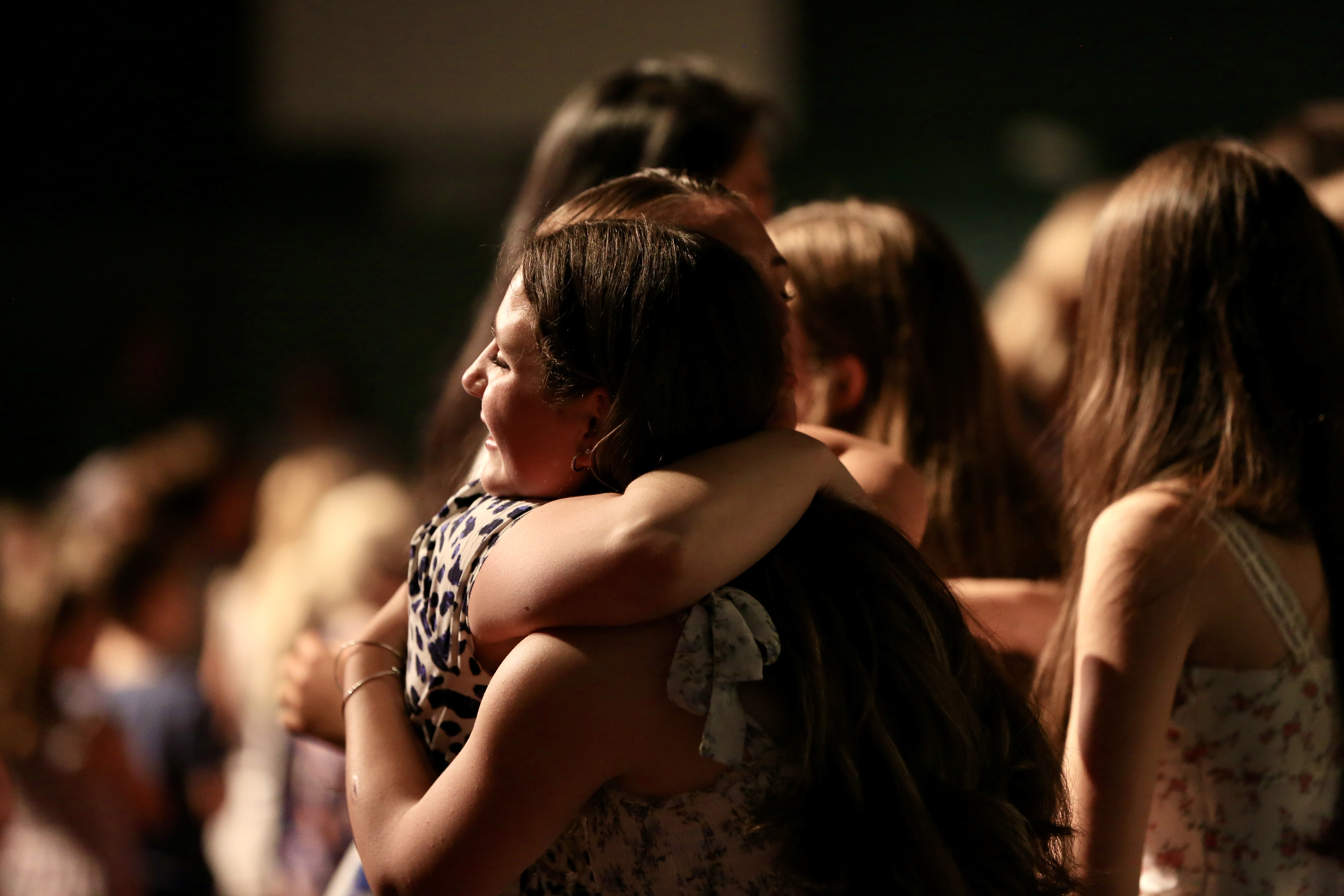
Beyond Brookwood
Brookwood's rigorous academic program cultivates innovative thinkers and ethical leaders. Led by Director Evan Diamond, our Secondary School Process guides students from 7th grade to find the right fit for their secondary education. Through personalized support and strong partnerships, we ensure each graduate finds their perfect match to excel further.